
Micah Chebus
Arrival in Marsabit and the first conversations: The moment I stepped off in Marsabit Town, an elder was already waiting at the roadside, as if he had been expecting me personally. “Welcome to Marsabit County-the Cradle of Mankind,” he said, extending a hand roughened by years under this sun. It was not the first time I had heard the phrase, but it stopped me all the same. I asked him why, and he obliged, unhurried: it was here, he explained, along the northeastern shores of Lake Turkana, the Sibiloi National Park and the Koobi Fora region-that some of the earliest human and prehistoric remains on the continent were unearthed. I told him it was my second time in this county. He smiled and said that meant I already knew Marsabit does not give itself away easily, and that whatever I had come to do, it would ask something of me before it gave anything back.
Later, I travelled onward to Logologo ward, where the terrain softened only slightly and the wind kept its promise of dust. Much of the day was spent in KIIs and a short community engagement with the area chief and a village elder, talking through grazing patterns, rangeland condition, and the quiet but persistent problem of Prosopis juliflora encroaching on land pastoralist households depend on. The conversation moved easily between natural resource management and peacebuilding, because out here the two are rarely separate questions; disputes over water points and grazing corridors are, more often than not, disputes over survival during drought.
The afternoon closed with final preparations before departure, reviewing the data collection guides, confirming the Kalacha and Laisamis itineraries, and going over the verification tools once more. This is Phase II of the feasibility study for Sign of Hope and Caritas Marsabit’s project to build resilient communities in Marsabit County to verify and update the baseline values Phase I established, so that whatever gets implemented on the ground stands on numbers that can be trusted.
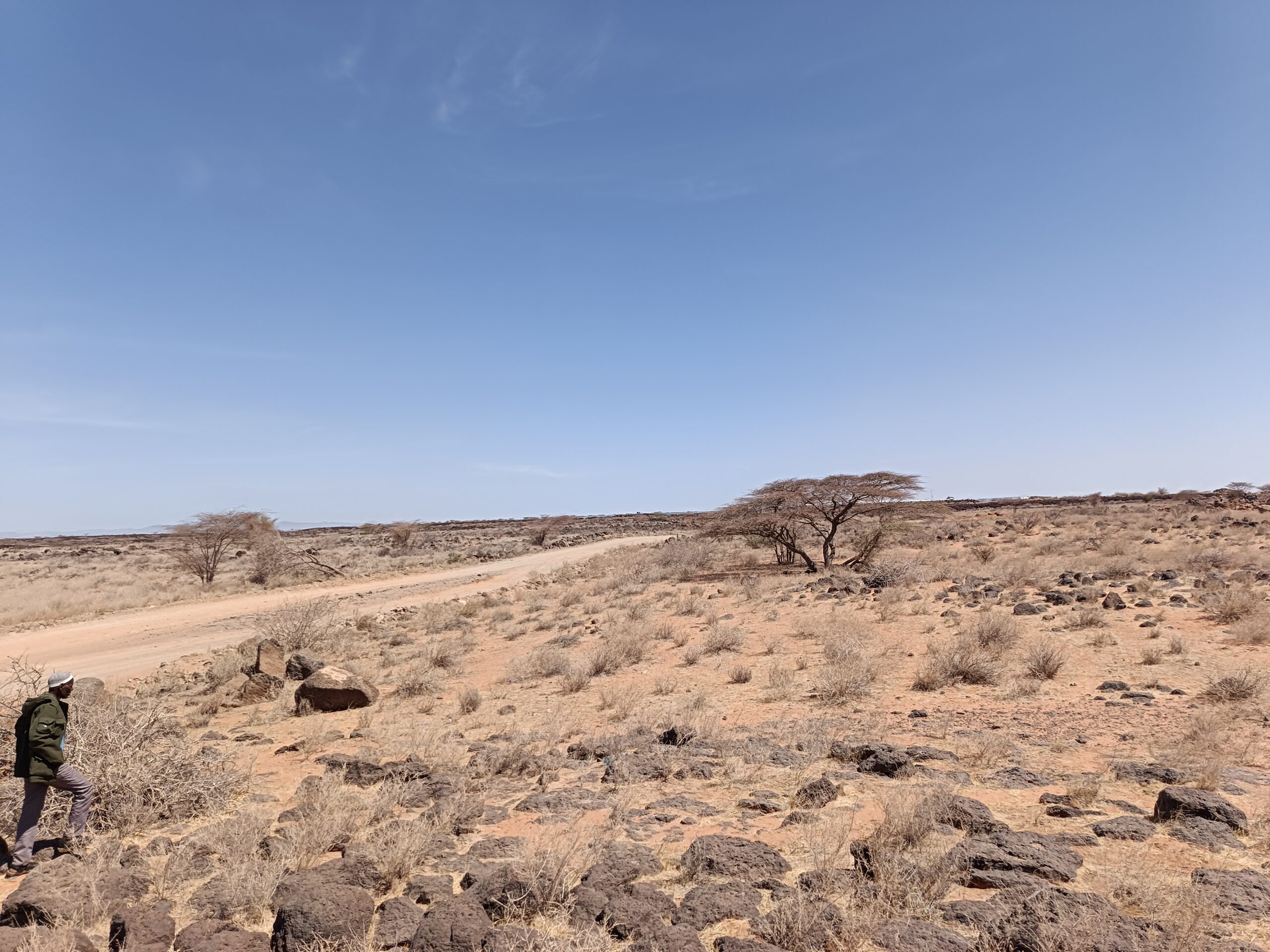
The road to Kalacha, via the Great Chalbi Desert: We left before the heat could fully claim the day, though it made no difference, by mid-morning the sun was already merciless. The drive from Marsabit town to Kalacha took just over four hours, more than two of them cutting straight through the Chalbi Desert. There is no road to speak of once the desert opens up, only a memory of tracks the vehicle ahead seemed to trust more than I did. We wound through the bush by feel, dust rising in thick curtains behind us, hot wind gusting sideways and, at one point, what looked unmistakably like a small tornado twisting somewhere off to the west.
We took two punctures before Kalacha came into view – the kind of delay that tests patience more than the tyres themselves. Each time, I worked quickly under the shade of the vehicle’s own shadow, because the schedule of stakeholder engagements waiting on the other side did not move for the desert. Kalacha in daylight is a different place from the one we arrived into at dusk the evening before – quieter, more deliberate. That evening began at Kalacha Primary and Junior School, where the head teacher walked me through the compound, and we talked through school records, sanitation facilities, and the state of the School Health Club, checking what the feasibility baseline had recorded against what stood in front of us, including latrine blocks in use, hygiene kits distributed, the small but telling signs of whether WASH investment on paper had become WASH investment in practice. From the school, I moved to a grazing land and Water Management Committee discussion near one of the community water points, tracing the same questions the project logframe asks in far drier language: is the water point functional, is it reliable through the dry months, who maintains it when it breaks.
School engagements and WASH observation: The journey took more than three hours and the sun was still scorching. I conducted several community and stakeholder engagements, with school observations at Merille Primary and Junior School, especially on the latrines, WASH points, and handwashing station.
The journey back and reflections: The return leg retraced our path through the Chalbi, and though the desert offered no fewer challenges going out than coming in, it felt somehow more familiar this time, less an obstacle, more a landscape I had earned a small right to cross. As Marsabit town reappeared and the fieldwork officially closed for this stretch, the Chalbi Desert’s winding, punishing, astonishing presence stayed with me. It is what Marsabit has always been to me: a place of extremes, of endurance, and of a strength in its people that no baseline survey can fully capture in a single indicator. This research expedition did more than move a project forward on paper. It grounded me, again, in the human stories that give meaning to phrases like climate-resilient WASH, natural resource management, and inclusive local governance – stories belonging to a head teacher in Kalacha, a women’s soap-making group, an elder who still remembers why they call this county the Cradle of Mankind. The Chalbi Desert has opened its harsh but beautiful soul to me once again, and I carry its lessons forward.